
Nurses step up strike action in Doncaster-Bassetlaw "fire and rehire" dispute
Strikes by intensive care nurses at a Doncaster area hopsital over fire and rehire contract changes will escalate across December, union chiefs have said.
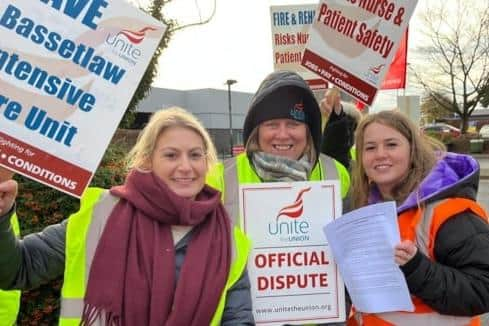
The nurses are striking over "fire and rehire” contract changes that Unite says will force them to rotate between Bassetlaw Hospital in Worksop and Doncaster Royal Infirmary.
The trust is threatening to dismiss the nurses from their current contracts and rehire them on new ones on 12 December, Unite has said.
The nurses fear the transfers are one more step towards Bassetlaw hospital losing its ICU permanently through ‘decommissioning by stealth’.

They would also face overly long commutes before and after 13-hour shifts, with the risk of exhaustion putting themselves and patients at risk, a spokesperson said.
Unite general secretary Sharon Graham said: “The trust’s abhorrent fire and rehire threats have only made the nurses more determined to fight against this blatant attempt to run down Bassetlaw’s ICU.
They have Unite’s 100 per cent support in standing up for themselves and patients.”
Unite is considering legal challenges to Doncaster and Bassetlaw Teaching Hospitals NHS Foundation Trust should it proceed with its plans.
A spokesperson said: “The trust claims the rotation plans are to increase the nurses’ exposure to level three patients (those who are ventilated or have multiple organ failure).
"The Trust’s proposal, however, would not guarantee increased exposure to level 3 patients. Unite believes the real reason behind the plans is to run down Bassetlaw’s ICU services.”
The nurses began action short of strike action through a ban on working on any ward or unit other than Bassetlaw ICU on 13 November and took two days of strike action in late November.
They will strike again from 15 December to 19 December. Industrial action will intensify is the dispute is not resolved.
Unite regional officer Chris Rawlinson said: “Unite offered the trust a cost-neutral plan that would give nurses more level 3 experience. Its rejection of the plan shows the real aim: the decommissioning by stealth of Bassetlaw’s ICU.
“Our members don’t want to strike, but they can’t accept proposals that undermine patient care and force unreasonable commute times on top of 13-hour shifts.”
A spokesperson for DBTHT said: “The action follows a dispute over the Trust’s proposal for ICU nurses at Bassetlaw to take part in an eight-week rotation each year to Doncaster Royal Infirmary, as part of a 12-month cycle, in order to maintain essential skills, competencies and experience.
“This level of clinical exposure is vital in intensive care, and the Trust believes it is the most effective way to ensure colleagues continue to have the specialist skills required to care for the sickest patients.
“Bassetlaw Hospital serves a much smaller population than Doncaster Royal Infirmary, which means it naturally sees fewer of the very ill patients that ICU nurses need regular hands-on experience with.
“National guidance, along with a recent peer review of intensive care services across South Yorkshire and Bassetlaw, highlights that ICU teams must have a minimum level of clinical practice to the sickest patients to maintain these skills.
“More of these patients are cared for day-to-day at Doncaster, which is why the Trust believes short-term rotation is the safest and most clinically effective way to keep specialist skills up to date and maintain a safe service within Worksop and surrounding areas, now and into the future.
“Rotation between sites is not new within DBTH. Several other clinical teams already move between Bassetlaw Hospital, Doncaster Royal Infirmary and Montagu Hospital as part of routine service delivery. This ensures consistency, shared learning and resilience across a multi-site organisation.
Karen Jessop, Chief Nurse at DBTH, said: “Our priority is patient safety, and that means ensuring our highly skilled ICU nurses maintain the level of competency critically ill patients rightly expect. Bassetlaw Hospital sees fewer very sick patients, and a short-term rotation with Doncaster is the safest and most effective way to keep those specialist skills up-to-date.
“We have worked closely with colleagues and unions, and we believe our offer is practical, supportive, and focused on enabling our teams to continue delivering the safest, highest-quality care.”