
Verdi's epic masterpiece Requiem to be performed in Doncaster
A musical masterpiece is coming to Doncaster – with a performance of Verdi’s classic Requiem in an unusual format.
When Rossini died in November 1868, Giuseppe Verdi proposed that a group of leading Italian composers should write a commemorative mass in Rossin’s honour.
Each composer would write one of the twelve sections of the requiem mass.
The score would be performed just once, on the anniversary of Rossini’s death, and then locked away as a solemn tribute.

This did not happen.
Verdi completed his own contribution, setting the Libera Me, very swiftly and it was still fresh in his mind when one of his other heroes, the Italian poet and novelist Alessandro Manzoni, died at the age of 89 in May 1873.
It was for this reason that he decided to extend it into the grand piece that is so well known today.
The premiere took place on 22 May 1874, at the church of San Marco in Milan.
Verdi conducted a 100-piece orchestra, a choir of 120, and four soloists, including the soprano (Teresa Stolz) and mezzo-soprano (Maria Waldmann) who had sung Aida and Amneris respectively in Aida (1871).
The event was a success and was quickly followed by performances at La Scala, after which Verdi took the work on a triumphal tour of Paris, Vienna and London, where he appeared at the newly built Royal Albert Hall.
It has been a firm choral favourite and has been performed many times since.
Move forward almost 150 years where Steve Robson, composer, created something different for Durham County Council’s BRASS festival – a transcription of Verdi’s famous creation to be performed by choirs and brass band.
A Herculean task and no mean feat to attempt to merge two musical traditions: choral and brass banding.
‘It was a fantastic educational process for me, transcribing every note into a brass band score. You got to see how he composed the piece, the musical patterns with the same fragments of tune coming in different guises.
"If you look at an orchestral score the violins tend to be the lead and some of the music they play is so fast and furious. The piccolo plays the highest notes. We’ve got a soprano cornet but no instrument that goes as high as a piccolo.
"Basically, I don’t have as many octaves of music to work with or the speed.’
In other words, not enough notes and the ‘Dies Irae’, emphasises the problem.
‘It’s the art of compromise,’ says Steve, ‘There isn’t a brass instrument that can go from up here to down there so I have to dovetail things, starting a run with one instrument and moving to another.’
However, despite the difficulties of transcribing from an orchestral to brass band scoring the task was achieved.
“As far as I know it’s a first,” Steve says. “A bit of brass band history.” This historic version was premiered, July 2019, at Durham Cathedral where the combined forces of Durham Choral Society, joined by the singers from Preston Hollow Presbyterian Church in Dallas, Texas and the Reg Vardy Band were all led by conductor Paul Leddington Wright.
Now this epic version comes to Doncaster to be performed, it is believed, for only the second time ever.
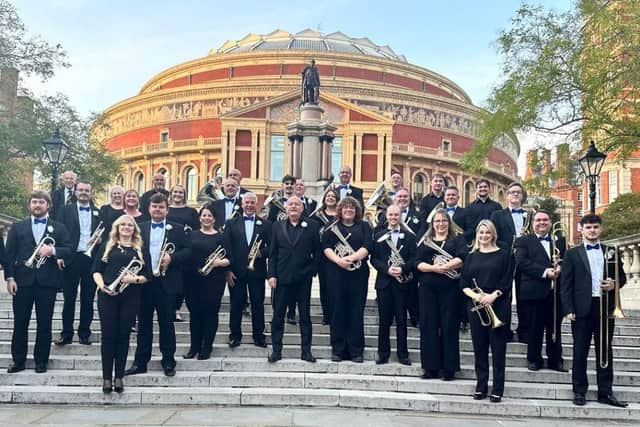
Doncaster Choral Society will be performing this arrangement on Saturday 15 March with the award winning Carlton Main Frickley Colliery Band, and soloists Debra Morley(soprano), Alison Hudson (alto), Gareth Dafydd Morris (tenor) and Tom Asher (bass) led by conductor Matt Beckingham.
Verdi Requiem: Saturday 15 March, 7.30pm.
Venue: Voice of God Fellowship CIC (Formerly Priory Place Methodist Church)
Doncaster, DN1 1TR
Tickets available from: https://wegottickets.com/event/643633
Or ticket sales: 01302 840728
Prices: £16 paid in advance
£18 on the door
£5 students, school pupils FREE