
"He was my hero": Moving tributes at funeral of Doncaster D-Day veteran
Moving tributes have been paid to a Doncaster D-Day veteran at his funeral following his death at the age of 105.
Fred Adamson, who served in the King’s Own Yorkshire Light Infantry from 1940 to 1946, passed away last month – and he was laid to rest with miltary honours at a moving service near his home in Conisbrough.
Proud grandson Philip Knight said: “Until his death, he was the King’s Own Yorkshire Infantry Regiment’s oldest surviving veteran and also believed to be one of Yorkshire’s oldest Normandy veterans.”
His funeral was attended by dozens of friends, family and members of his regimental association plus the Deputy Lord Lieutenant Major Adrian Hunt representing the King, Doncaster’s Mayor Ros Jones, and John Breckin of Rotherham United Football Club, of which Mr Adamson was a lifelong fan.
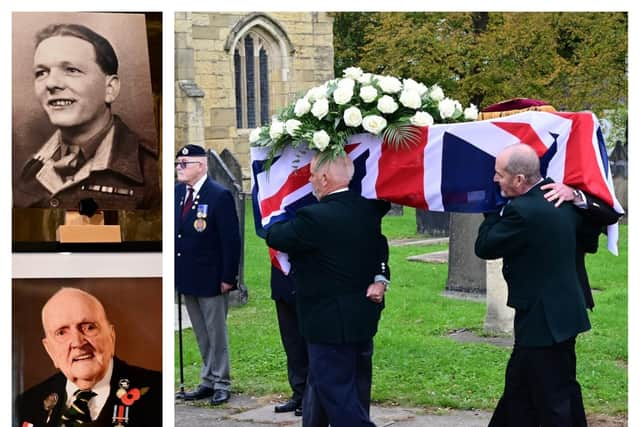

Padre Capt Albert Jackson talked of Fred the family man, fondly remembering him producing five children, 11 grandchildren 11 great grandchildren, and one great, great grand child.
He said: “His military career is an example to all, of what these men suffered during the time of real conflict in the world. He was more than just a soldier because he did so much for so many other people and so many ways. And that's what makes people like Fred so unique. They are one offs..
Philip added: “The sentiments expressed about grandad Fred paint a deeply moving portrait of a man who was not only admired but profoundly loved and respected across family, generations and nations.
"Fred is remembered as a gentleman of the highest order, a hero, and a humble yet brave soldier, hardworking, a family man whose legacy will endure.
"Family, friends, veterans, historians, and his local community, and international communities – from France to Holland – honored his service in World War Two, especially his role in the liberation of Holland and France.
“To me he was a kind, supportive and loving man, a living connection to history, and a symbol of courage and sacrifice. His passing marks the end of an era, to me the recurring themes of gratitude, honour, and remembrance reflect how Fred’s life touched countless others. He was my hero.”
Fred was also subject to a tribute at York Minster at a KOYLI memorial service and Philip added: “It was a very nice touch, and again a great example of the support that the Regimental Association and friends have shown.
"They have been great and did Grandad proud at his funeral. I wore Grandad’s medals this made me very proud as ever and very sad at same time.”
Fred passed away on September 12.
Born in 1919, he lived an extraordinary life.
He witnessed the reign of five monarchs and the terms of 23 different prime ministers.
Added Philip: “He was super proud of his birthday cards from Queen Elizabeth II at 100 and King Charles III at 105.
"Fred served his country during the Second World War and dedicated 46 years of service to the National Coal Board and its predecessors.”
Born at Cross Street, Kimberworth, Rotherham, in 1926, his family moved to Conisbrough as his father sought work at the local mine.
Tragically, his father died in 1931 due to an accident at Cadeby Colliery.
Fred attended Morley Place School and later Mexborough Grammar School, having passed the West Riding Examination (11 plus).
Fred's first job was as a wages clerk at Amalgamated Denaby Collieries Ltd. Determined not to follow his father and brothers into the mines, he pursued a white-collar role. But World War II interrupted Fred's initial employment.
He was called up on 15 February 1940 and after training at Strensall Barracks was posted to the 1/4th Battalion, Kings Own Yorkshire Light Infantry (KOYLI).
He served in Iceland from 1940 to 1942, trained in Arctic warfare, and participated in the Normandy invasion on 10 June 1944 and fought through north west Europe, France, Belgium and Holland.
Fred was involved in intense fighting in Cristot and Tessel Wood, France where he experienced significant opposition and lost lots of his comrades. He was wounded by shrapnel on 9 October 1944 at Poppel on the Belgium border with Holland.
His cigarette cases saved his life and his injuries were limited to his legs.
He married his beloved wife Elsie in January 1945 whilst he was back in England whilst recuperating.
They went on to have have five children: Christine, David, Janet, Gill, and Anthony.
Fred had eleven grandchildren and eleven great-grandchildren and more recently a great, great grandchild.
After he had recovered from his wounds, Fred returned to his regiment at the front in Holland and fought through several battles, including the second battle for Arnhem.
He was in Utrecht in May 1945 when the Germans surrendered.
After Germany surrendered Fred’s service continued in Germany, Italy, and Austria, performing various duties, including protecting civilians, and policing duties.
Fred was demobbed in 1946 and returned to his job in wages in the Coal Industry, serving a total of 46 years and finishing in management. In retirement he was a keen gardener something he enjoyed until his age prevented it.
Fred was a lifelong Rotherham United fan and attended all home matches during his lifetime when his health permitted, but when it didn’t, he still followed their progress.
He was grateful for the club's support and attendance at his birthday events, with club ambassador John Breckin visiting him in August this year with a framed centenary shirt and a placque describing him as Rotherham United's oldest surviving supporter.
Added Philip: “Fred's war service was a source of immense pride to his family.
"I accompanied him on several battlefield tours and regimental events. He was awarded the Legion d’Honneur in November 2016 by the French Government for his involvement in the liberation of France, a recognition he cherished deeply.
"Fred was amazed at the gratitude and friendship shown by the French and Dutch on his trips, he received a civic reception of thanks in Fontenay-Le-Pesnel in 2022 when his made his last visit which including paying respects again at the grave of Ronnie McGrath also from Conisbrough who was killed age 17 years of age, the youngest in Fred’s regiment to be killed in action."
In 2024 he was made a honorary member of the Dutch Polar Bears an organisation who keep the memory of the original ‘Polar Bear’ division alive and was recognised by the Forgotten Liberation group for his part in the second battle of Arnhem (Operation Anger) in April 2025 at a civic event which grandsons Philip and Christopher attended on his behalf.
Added Philip: “Fred's 100th and birthdays beyond were celebrated with great joy, and he became somewhat of a media sensation for his remarkable life and service, something he never quite understood.” Fred was until his death the oldest surviving KOYLI veteran, his regimental association was a source of great support, and he made a great deal of new comrades and friends through this association, they supported his final trip of remembrance in 2022, a trip he remembered with great joy.
He was also a Royal British Legion (RBL) branch member in Conisbrough; the RBL UK arranged the 75th Anniversary Tour in 2019 which was Fred also was fortunate to attend and really enjoy. He aso featured in a book, “Normandy 1944 - They Were There - Forty Veterans Remember,” by author Gilles Leffray.
Discussing his wartime exploits in an earlier interview on his 100th birthday, Fred said: “Our Battalion landed in Normandy on Gold beach on 10 June 1944.
"When we left the assault craft, most of us had to wade in the sea at waist height – in my case, as I am only 5 feet 2 inches, it was almost up to my neck – to reach the beach.
"It was all rather frightening not knowing what we were going to encounter, but by this time the beaches had been cleared of the enemy and there was only gunfire here and there.
"A few days later, after marching inland we made our first contact with the Germans when we entered a copse and found the enemy facing in at the other side and only about 40 metres away, our first real experience of enemy fire.
“Our first major operation on 16 June 1944 was to take part in the attack on Cristot.
"During and following the attack, eight of our Battalion were killed, including five from my Company, 'A' Company and 30 or so wounded.”
He nearly lost his life in October 1944 – but was saved because he was a smoker.
Explained Fred: "I was wounded on 9 October 1944 at Poppel on the Belgium side of the Dutch border when I was hit by shrapnel.
He added: “I knew I’d been hit as my leg was blooded but it wasn't until I was at the field hospital, when I was given some cigarettes that I realised what had happened.
“As I went to put them in my cases, I realised my two cigarette cases had saved my life.
"The shrapnel went through the top of first, clipped each page of his army pay book and then dinted the second case.”