
Former Doncaster Rovers star and manager who became artist to close city gallery
A former Doncaster Rovers footballer who also enjoyed a career as a manager before becoming an acclaimed artist is to close down his art gallery in the city.
John Bird, who played for Rovers between 1967 and 1971 and also enjoyed lengthy spells at Preston North End, Newcastle United and Hartlepool United before going into management with the latter and then York City, became an artist after hanging up his boots, opening up the John Bird Studio in Bawtry.
The 77-year-old has announced that the gallery will close its doors later this year.
Fellow artist Tony P Byrne said: “The John Bird art gallery in Bawtry will be closing at the end of March 2026 after many years.
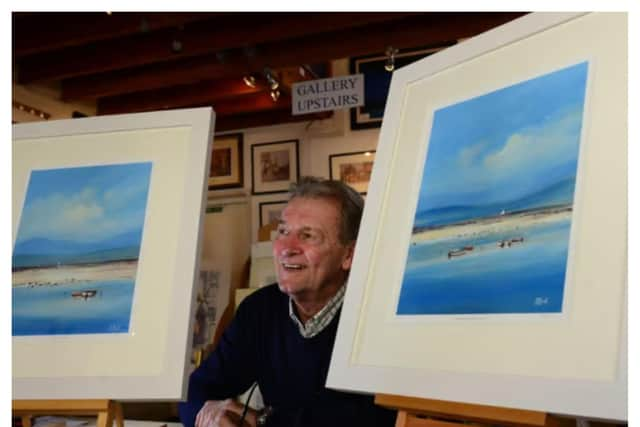

“I used to show my artwork in five galleries till a few years ago, but as I got older I pulled out of four of them.
"John’s gallery is the only gallery my work is in at the moment. We have been friends for many years.
“So if you want a bargain and to help John Bird on his way, go along and see what you can buy for up to 50% off.”
In an interview about his footballing days in 2015, Bird explained how Arsenal legend Charlie George sidled up and knocked out his front teeth during a match when he was playing for Newcastle.
After finally leaving the game, he turned his attentions to art, opening up the gallery packed with original portraits, landscapes, wildlife images, photographs and prints.
Recipients of his paintings include Prince Edward, the Duchess of Wessex, the Governor of Hong Kong, opera diva Lesley Garrett and actor Russell Crowe.
Tate Britain invited him to London to take part in a collaborative project and exhibition where 30 artists selected a drawing out of the gallery’s JMW Turner archive to make their own interpretation of it to be exhibited alongside the original.
The idea was to give an insight into the methods, inventions and creativity of a master draughtsman.
John started what was to become his second career at the height of his first one at Newcastle, playing in the First Division at St James’s Park and in Europe.
He opened a gallery in the city selling Athena prints and converted the space upstairs into a showcase for new work by local artists.
He acknowledges that professional footballers in those days had a lot of time on their hands when training was over. There were time-honoured ways of filling it in but they didn’t appeal to him.
“Snooker and golf, I never liked any of them,” he says. So he went off painting instead.
As a Newcastle United star he was living at Whitley Bay and enjoyed doing local landscapes like Bamburgh Castle or the fish quay at North Shields.
His big artistic break came from abroad. “We had a lot of Norwegians over on the ferry. They bought a lot of my work and they came back the following year.”
At the end of one season the phone rang and he was offered a one-man show in Stavanger. “I hired a van and went over. It was a complete sell-out and I went back again next year.”
John went to grammar school in Doncaster and left sixth form to become a chartered surveyor.
He had passed the first of his professional examinations when professional football came knocking. He had been starring as a centre half for a top local amateur side where his mentor was his old PE master, Eddie Beaglehole.
Aged 18, John made his Doncaster Rovers debut away at Workington Town. “For me it was as big a game as any I’ve played in. We drew 2-2 and I gave away a penalty.” But the manager, Lawrie McMenemy, had to sell his best players to survive. After a dozen games, Preston North End spotted the potential in the young defender.
He soon found he had stepped up from the Fourth Division to the Second Division big-time at Preston who could attract 37,000 to watch a home match at Deepdale against Manchester United.
One of United’s greats, Sir Bobby Charlton, promptly came in as the Preston manager and made John, then aged 24, his captain.
But Charlton’s managerial career stuttered. Preston were relegated and Gordon Lee, the manager of neighbouring Blackburn, who coveted the young Preston captain, was promoted to boss of First Division Newcastle United.
Lee made a secret move for John after a meeting on a team coach. Charlton, however, had been left out of the loop. “I approached Bobby the next day,” says John.
“He knew nothing, he just said: “They’re not selling you”. When they did, Charlton walked out of Deepdale in disgust and out of football management for good. His number two, fellow World Cup winner Nobby Stiles, resigned too. John’s final managerial job was at non-league Halifax Town.
Getting another career off the ground required hard graft and an eye for the commercial potential in the type of subject he chose to paint. “I’d take a gamble and go into towns like Thirsk, Beverley, Grassington. I would do local scenes and tourist scenes, working for three weeks and then go on the road for a week selling signed prints at stately homes and gift shops and tourist information centres. I lived off them for ten years.”
John was also commissioned by English Heritage to provide signed prints of Stonehenge, Osborne House – the former royal residence on the Isle of Wight – and Kenwood, the Robert Adam villa in London. He also did work for the National Trust and the Wildlife Trust.