
Down Memory Lane - Part 2: Flashback to the Isle of Axholme in days gone by
Colin Ella is a local writer whose work has been published widely in many journals, magazines and newspapers.
The Doncaster Free Press has a new ‘retro’ section which Colin will be regularly contributing to. Colin used to write for the Free Press’s former sister paper, the Epworth Bells, before it closed.
In the forthcoming pieces we will roam widely in the Isle of Axholme to discover how things were decades ago.
Eastoft once stood on the bank of the earlier course of the River Don and houses on the left of this lovely old photograph would have stood in the old river bed.


For centuries the village had its Yorkshire and Lincolnshire sides each with its Hall. Its Danish name is Eschetofth which means the ‘toft by the ash grove’. This early 20th century view of High Street looking north is full of character.
Coal merchant, Fred Harrison lived in the second house on the right in the 1930s and the third house was that of Marshall Elviss, a farmer, and his father before him.
The fourth property was a grocer’s shop and next door, Central House’ belonged to the agricultural engineers, Belton Brothers and Drury. Far right was Fowler’s Corn Mill, one of the first to use a Ruston and Hornsby engine.
The former Methodist chapel is off scene to the left but there was an earlier Wesleyan chapel at the end of this road on the left.
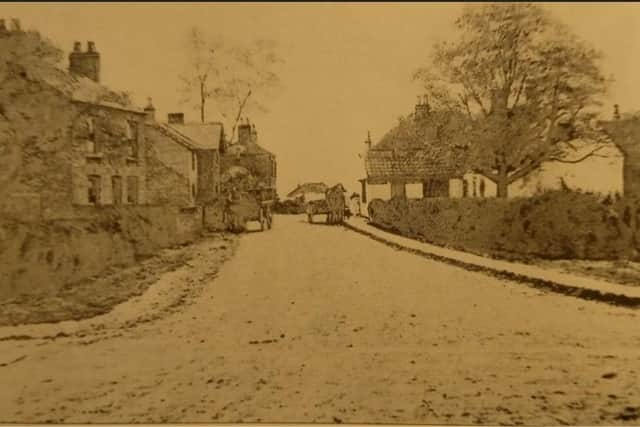
Following the road from Garthorpe along the Trentside way you enter the quiet village of Amcotts. This view pictures the peaceful village in 1915.
The Domesday inventory calls it Amecotes and for centuries it was the property of a family called Amcotts.
It had a population of 300 in the 1930s.
We are looking down Chapel Street here where John Hugh Chapman had the Post Office in the White Cottage on the right. It is believed the lady
whose body was found buried in the peat had wandered out from this village. She was interred in the cemetery here.
In 1940 a frozen River Trent saw eight people pick their way through the ice to Flixborough and back.
They were Edwin Oliver, Frank Walker, Jack Tomlinson, Tom Wartledon, Leslie Thornton. Tom Brown and Mr and Mrs Harrison.