

Doncaster Free Press has a new ‘retro’ section which Colin will be regularly contributing to. Colin used to write for the Free Press’s former sister paper, the Epworth Bells, before it closed.
In the forthcoming pieces we will roam widely in the Isle of Axholme to discover how things were decades ago.
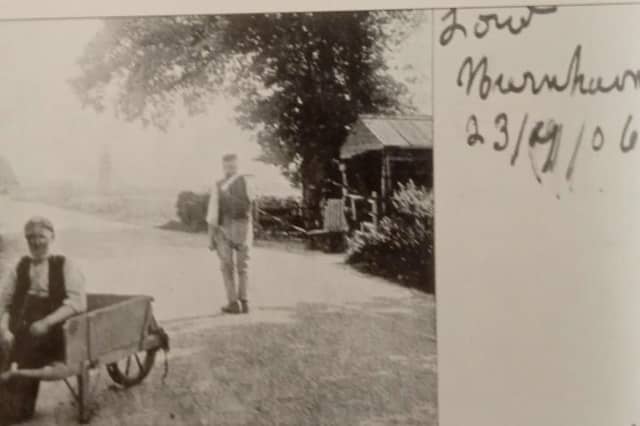
Two fellows blithely occupy the road without fear of oncoming vehicles. The card pictures the Belton Road leading into Epworth and Brook’s Mill can be made out far right (these days a private residence) .
The postcard also tells us the date, where it comes from, who sent it and even gives us a message.
I was told that the man in the barrow was a Mr Watson.
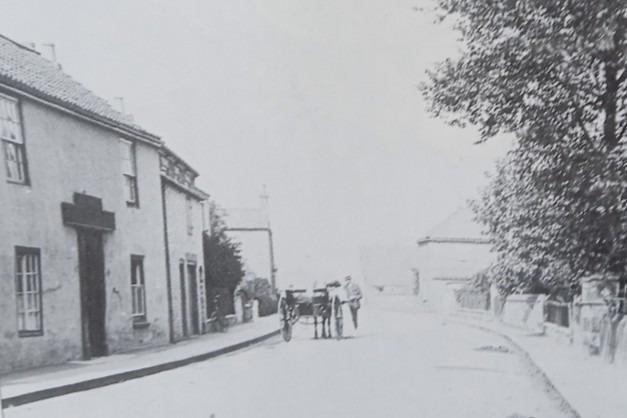
A pre-1920s shot of Belton Road leading out of Epworth.
Off shot right is Kilham House, the one time home for the Kilham Memorial church minister.
Later it served as the Kelham House residential home before becoming a private house.
The White Bear Inn, first left has 18th century origins with later additions.
Epworth has some 40 listed buildings which include churches, inns, houses, barns, mills, monuments and the White Bear is one of them.
Once Epworth had over a dozen outlets for alcohol but by 1850 there were just six inns and three beerhouses. The remaining five inns then were the Half Moon, King’s Head, Queen’s Head, Red Lion and the Royal Oak.
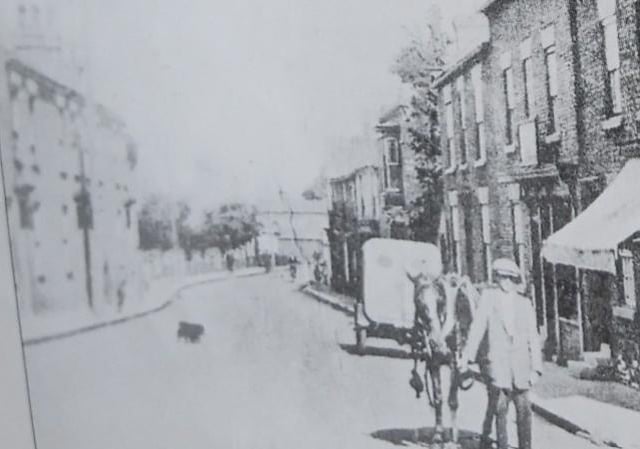
There are no parking problems in this 1920s view of Epworth High Street looking west.
Its Victorian elegance is plain to see and Robert Brown is pictured with his horse outside his shop.
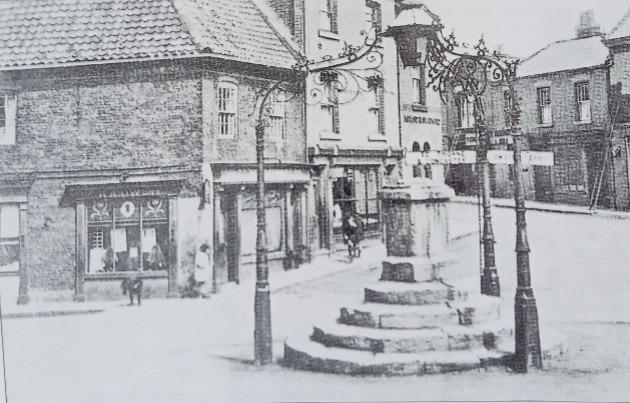
The handsome, decorated, three-pillared ornamental ironwork in around the stone cross in Epworth Market Place was erected by public subscription to commemorate the coronation of King Edward VII.
The shop on the left was AA Owen’s gentlemen’s outfitter and next door was Arthur Barratt’s greengrocery and confectionery
business.
London House, on the far right, was also an outfitters and upstairs hats were made.
Shillito’s came next, the hardware shop, and in Waterloo House on the corner at the junction of Market Place and Hollingsworth
Lane, was Mellor’s Café. Note that the road passed all round the cross at this time.
A mid 20th century shot of the Market Cross not long after the ornamental decoration had been removed.
We are looking up Queen Street where the poorhouse with its lockup behind used to be on the left. The fine Georgian
house first right was a restaurant for a time.
Other shops are seen before the white fronted Queen’s Head Hotel. I do not know the name of the cleric standing on the cross
from which John Wesley often preached.
3. Axholme in days gone by
The market cross as it looked with its ornate ironwork surround. Photo: Submitted