
Doncaster man, 31, almost dies after 'running injury' turns out to be a sign of deadly brain cancer
A man's 'running injury' turned out to be a sign of deadly cancer.
Sean Ryan Sweeney, aged 31, began experiencing frequent headaches, muscular pain in his neck and tingling down the right side of his body.
He thought he'd torn a ligament in his neck while running or weight training and went to a physiotherapist but had no relief after a few sessions.
After his wife, Lucy, aged 28, found him having a seizure at home he was rushed to Doncaster Royal Infirmary and later diagnosed with a grade 3 astrocytoma – an aggressive form of brain cancer.

Doctors said the tumour was incurable and that Sean had just ten more years to live.
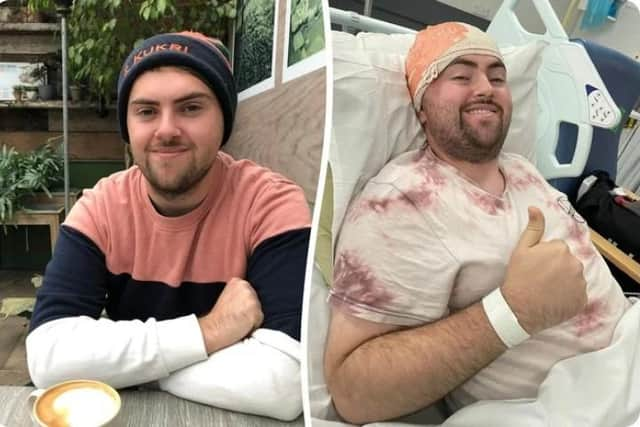
Following five weeks of radiotherapy and 12 rounds of chemo his condition is said to be stable.
Sean, a senior accounts director, from Doncaster, said: “I genuinely thought I’d picked up an injury and that physiotherapy would get to the bottom of it.
"I went through several physio sessions, but nothing improved.
"In the end, the physio told me they couldn’t identify the cause of the pain and discharged me, which was worrying.
"I remember feeling frustrated and unsettled, thinking, I don’t feel right, but not being able to explain why. I was struggling to concentrate and the symptoms just kept lingering."
Sean's symptoms started in January 2022 before he had the seizure in July 19 of the same year.
He said: “Then, everything escalated suddenly. I was woken in the early hours by my partner, Lucy (now my wife), after I had a seizure.
"She called 999 straight away and within 20 minutes I was blue-lighted to Doncaster Royal Infirmary.”
Doctors carried out a CT scan and a junior doctor told him there was something concerning on his scan.
Sean was referred to the neurospecialist team at Sheffield Royal Hallamshire Hospital, where further CT and MRI scans were carried out.
Initially, surgeons believed the tumour might be low-grade, but this was later found not to be the case.
He said: "When I was told they’d found a lesion on my brain, I felt completely numb.
"I didn't cry or panic. My mind went straight to Lucy and my family."
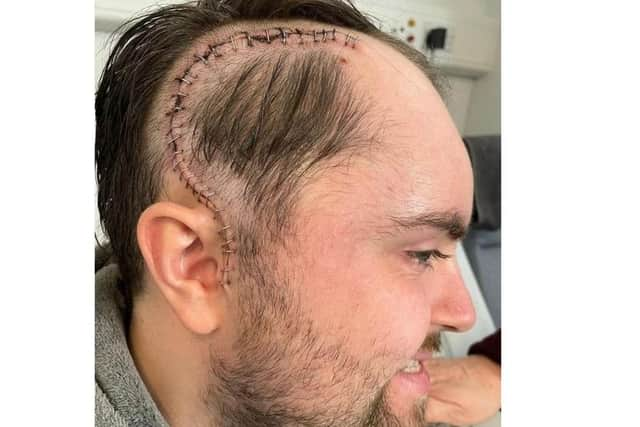
He underwent a nine-and-a-half-hour awake craniotomy to debulk the tumour in the November.
Sean experienced an acute stroke during his surgery, which left him struggling to walk and a droop on the left side of his face.
He said: "Before the operation, I had sessions with a clinical psychologist who talked me through everything from the moment I arrived at hospital to discharge.
"When the team explained the awake craniotomy, they said I seemed calm and unfazed, but it was still a huge thing to face.
“Because I was awake, I remember the exact moment things changed.
"I could hear the psychologist telling the surgeon my speech was becoming slurred. The next day I had problems walking and one side of my face had dropped.
"Later, I was told I’d had a stroke during surgery. It was frightening, but thankfully, with rehabilitation I recovered and today you wouldn’t know I’d had a stroke at all.”
After the surgery Sean was diagnosed with a grade 3 astrocytoma.
Sean started his chemo and radiotherapy at Weston Park Hospital in early 2023, finishing in February 2024.
Sean is sharing his story and fundraising for Brain Tumour Research, the only national charity focused on finding a cure for all types of brain tumours.
Sean and father-in-law Carl Hathaway, aged 59, raised over £2,500 completing Sir Chris Hoy’s 60KM Tour de 4 cycling challenge together, and are planning to step up to the 100km route next year.
Sean said: “Carl drove me to so many of my radiotherapy sessions and, in those journeys, our bond really strengthened.
"Even in the darkest moments, we somehow found a way to have a laugh.
"He’s become the father figure I never had.
“We both love cycling, so when the Tour de 4 was announced, we were keen to take part.
"Completing it together was a massive milestone for me – it was the first endurance event I’d ever finished – and I couldn’t quite believe I was capable of doing it after everything my body had been through.
“It’s shocking how little funding brain tumours receive compared to other cancers.
"Finishing treatment doesn’t mean everything goes back to normal – you’re still living with the impact, and for high-grade tumours like mine there still isn’t a cure."
Ashley McWilliams, community development manager at Brain Tumour Research, said: "It is only with increased funding and more research that we can find a cure for patients like Sean.
"His experience also highlights the reality that treatment can be gruelling and recovery can be long, with life-changing consequences even when someone looks well on the outside.
“We are incredibly grateful to Sean for sharing his story and for supporting our work through fundraising to help change the story for brain tumour patients.”
To support Brain Tumour Research visit: